Research and development
Published science that is not yet a product.
We develop wound care devices for the conditions Canadian patients actually live in. Turning the research into something a clinic can order is the work.
Where the work has gone deepest
Most of our completed studies sit in wound care and limb preservation: diabetic foot ulcer clinics, multidisciplinary limb preservation programs, and the imaging and metadata collected around them. It is where the specialist network, the site relationships and the published work line up, and it is why the device work starts here.
- 2021 Reduction in Diabetes-Related Major Amputation Rates After Implementation of a Multidisciplinary Model: An Evaluation in Alberta, Canada
Journal of the American Podiatric Medical Association 111 (4)
- 2024 Protocol for metadata and image collection at diabetic foot ulcer clinics: enabling research in wound analytics and deep learning
BioMedical Engineering OnLine 23 (1), 12
- 2024 Effectiveness of a Multidisciplinary Limb Preservation Program in Reducing Regional Hospitalization Rates for Patients With Diabetes-Related Foot Complications
The International Journal of Lower Extremity Wounds
Ongoing R&D Pipelines
-
Dressings come off in cold, wet, high-shear conditions. It is treated as an inconvenience rather than as a design problem, and the patients it happens to are the ones least able to reach a clinic to have it replaced.
Why this matters
Infection is the route from an open ulcer to amputation, and one of the few controllable steps in that chain is whether the dressing is still on the wound between clinic visits. The burden is not spread evenly: leg amputation rates run from 7 per 100,000 in easily accessible urban centres to 49 per 100,000 in very remote communities. Those are the patients furthest from a wound clinic, and the ones whose dressings have to hold longest.
- Amputation hospitalizations
- 7,720 per year, Canada
- Ulcer, gangrene and infection
- 23,500 hospitalizations per year
- Annual hospitalization cost
- $750M
- Lifetime risk of a foot ulcer
- 15 to 25% of people with diabetes
Figures: Canadian Institute for Health Information, Equity in diabetes care: A focus on lower limb amputation, 2020-2021 to 2022-2023.
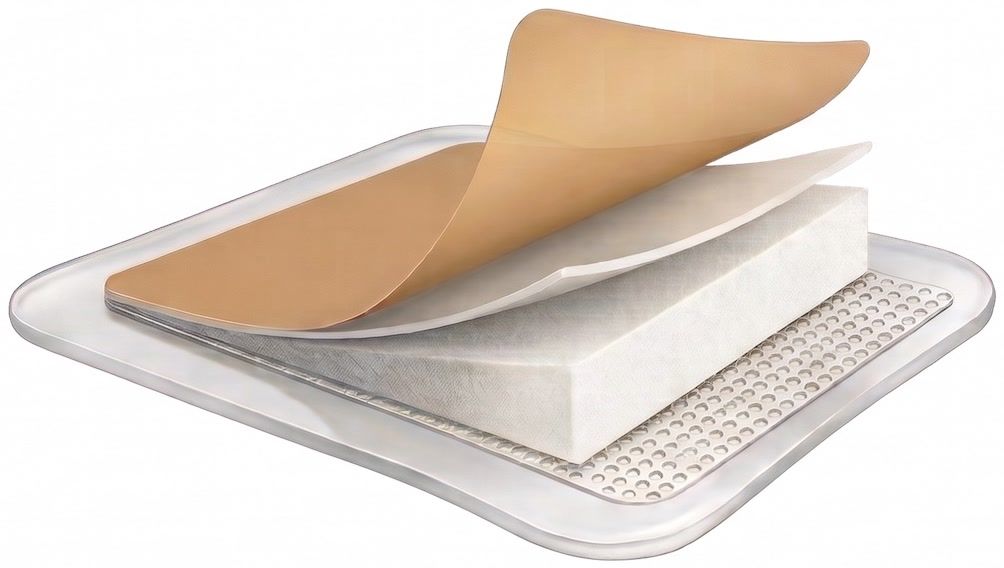
Design render. Materials and performance specifications are not published. Characteristics
The wound contact layer sits on the ulcer without bonding to it, and lifts away without taking fragile skin with it. Above that, an absorbent core draws exudate away from the wound and holds it there, a thermal buffer evens out the swing between an outdoor shift and a heated room, and an outer film keeps slush and meltwater out while still letting vapour escape. Around all of it runs an adhesive border built to hold on cold skin, through repeated wet and dry cycling, and against the shear of a boot.
Manufacturing and distribution of MedProactive's R&D pipeline are handled by our sister organization Kanjin Health (Health Canada MDEL 34406).
Manufacturers and collaborators.
We are looking for a partner with
- Medical grade elastomer processing
- Adhesive formulation
- Coating and converting under ISO 13485